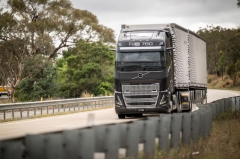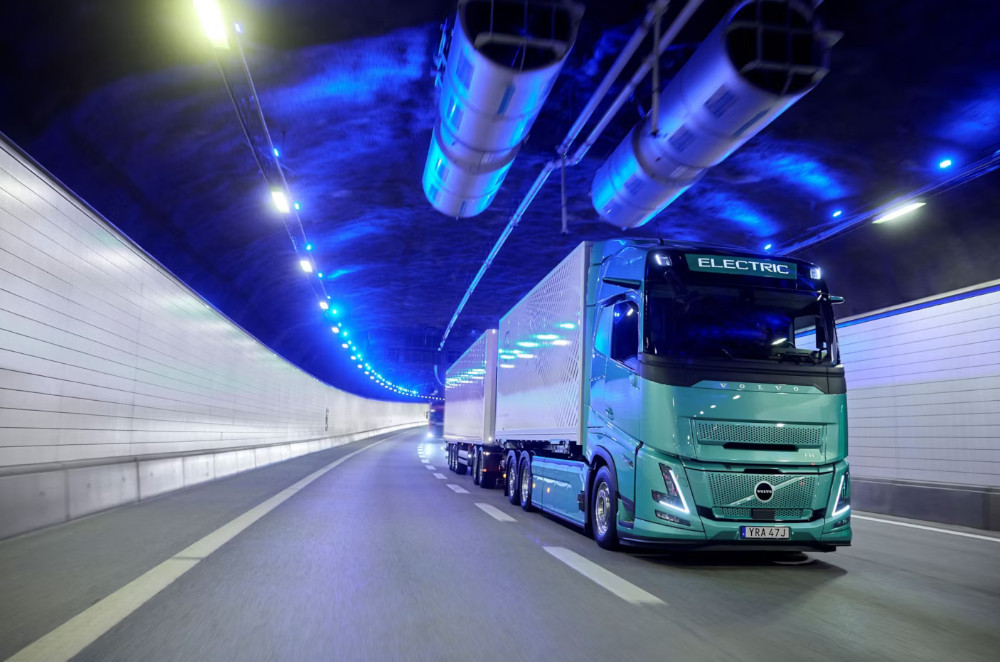
Volvo Trucks is taking its electric trucks into new territory with a new FH Electric and FH Aero Electric configuration capable of handling combinations weighing up to 80 tons. The extended-range setup is aimed at transport jobs where battery-electric trucks have traditionally faced limitations, including long-distance hauling and demanding work with heavy trailers.
At 64 tons, Volvo says the electric truck can travel up to 450 km on a full charge. That figure drops slightly to 420 km when operating at legal combination weights of 74 to 76 tons, giving operators more flexibility for heavier transport applications.
The new configuration gets 640 kWh of usable battery capacity, along with updated battery monitoring and improved insulation for colder operating conditions. Power is sent through an eight-speed transmission designed specifically for electric drivetrains, while hub-reduction axles are available for applications such as timber hauling and light construction where additional traction and ground clearance are useful.
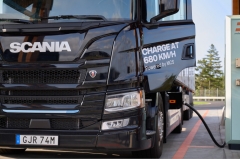
When it comes to replenishing the batteries, the truck supports Megawatt Charging System (MCS) technology at up to 680 kW, allowing the battery to go from 20 percent to 80 percent in around 36 minutes. A 360-kW CCS2 charger can achieve the same charge level in approximately 70 minutes.
Volvo has also fitted the truck with an electric power take-off. Similar to the mechanical power-takeoff feature in diesel trucks, this allows equipment such as refrigeration units to draw power without relying on a separate diesel generator, further reducing the need for combustion-powered auxiliary systems.
The new FH Electric and FH Aero Electric rigid models will initially be sold in Sweden, Norway, Finland, Denmark, the Netherlands, and Switzerland. Volvo plans to begin rolling out the new high-capacity variants gradually from early 2027. As for the Philippines, only time will tell if these state-of-the-art EV trucks will make their way here.